Title here
Summary here
LeMat-Synth is an open-source multi-modal toolbox for extracting structured synthesis procedures and performance data from materials science literature at scale. It was presented at NeurIPS AI4Mat 2025.
Tutorial and documentation were provided by Stefano Ribes!
LeMat-Synth is an extensible pipeline that parses scientific PDFs using large language models (LLMs) and vision-language models (VLMs) to produce structured, machine-readable records of material synthesis and performance.
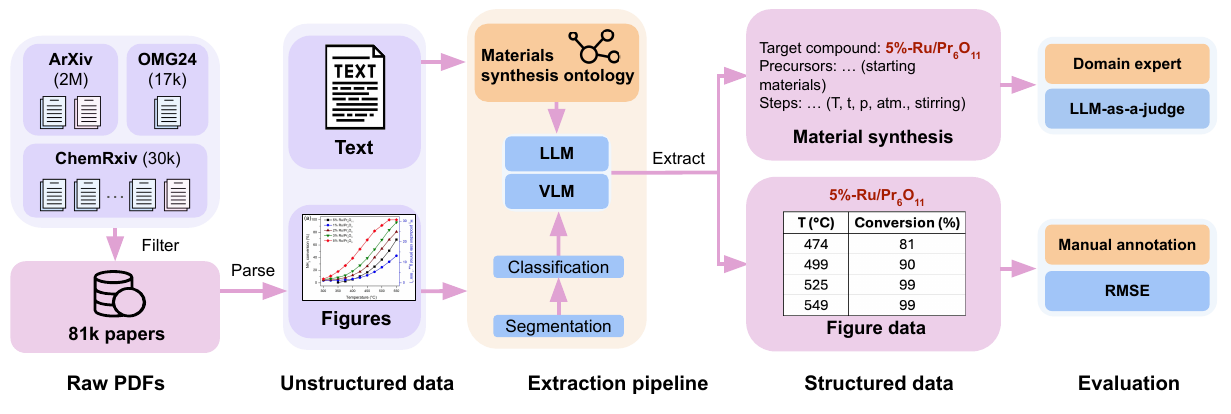
For each paper processed, LeMat-Synth outputs:
Synthesised materials — The actual materials fabricated in the paper, distinguished from materials merely cited or compared against.
Structured procedures — Step-by-step synthesis recipes including reagents with amounts and purity, temperatures, durations, and atmospheres.
Performance data — Quantitative values extracted from figures in the paper using VLM technology, including axis labels and plot coordinates.
Quality scores — An LLM-based rating across five dimensions to indicate extraction confidence.
A typical output record looks like this:
{
  "material": "Ru/MgO(110)",
  "synthesis_method": "wet impregnation",
  "reagents": [
    {"name": "RuCl3", "amount": "0.15 g", "purity": "99.9%"}
  ],
  "steps": [
    {"description": "Dissolve precursor in water", "temperature": "25°C", "duration": "30 min"},
    {"description": "Impregnate support", "atmosphere": "N2"},
    {"description": "Calcine", "temperature": "500°C", "duration": "4 h", "atmosphere": "air"}
  ],
  "performance": {
    "metric": "NH3 conversion",
    "value": 78.5,
    "unit": "%",
    "conditions": "400°C"
  },
  "quality_scores": {
    "completeness": 0.9,
    "consistency": 0.85
  }
}The pipeline has four composable components:
"Temperature" × "Conversion %").The LeMat-Synth v1.0 dataset was built from over 80,000 open-access papers and covers:
If you use LeMat-Synth in your research, please cite:
@misc{lederbauer2025lematsynth,
  title={LeMat-Synth: a multi-modal toolbox to curate broad synthesis procedure databases from scientific literature},
  author={Magdalena Lederbauer et al.},
  year={2025},
  eprint={2510.26824},
  archivePrefix={arXiv},
  primaryClass={cs.LG}
}